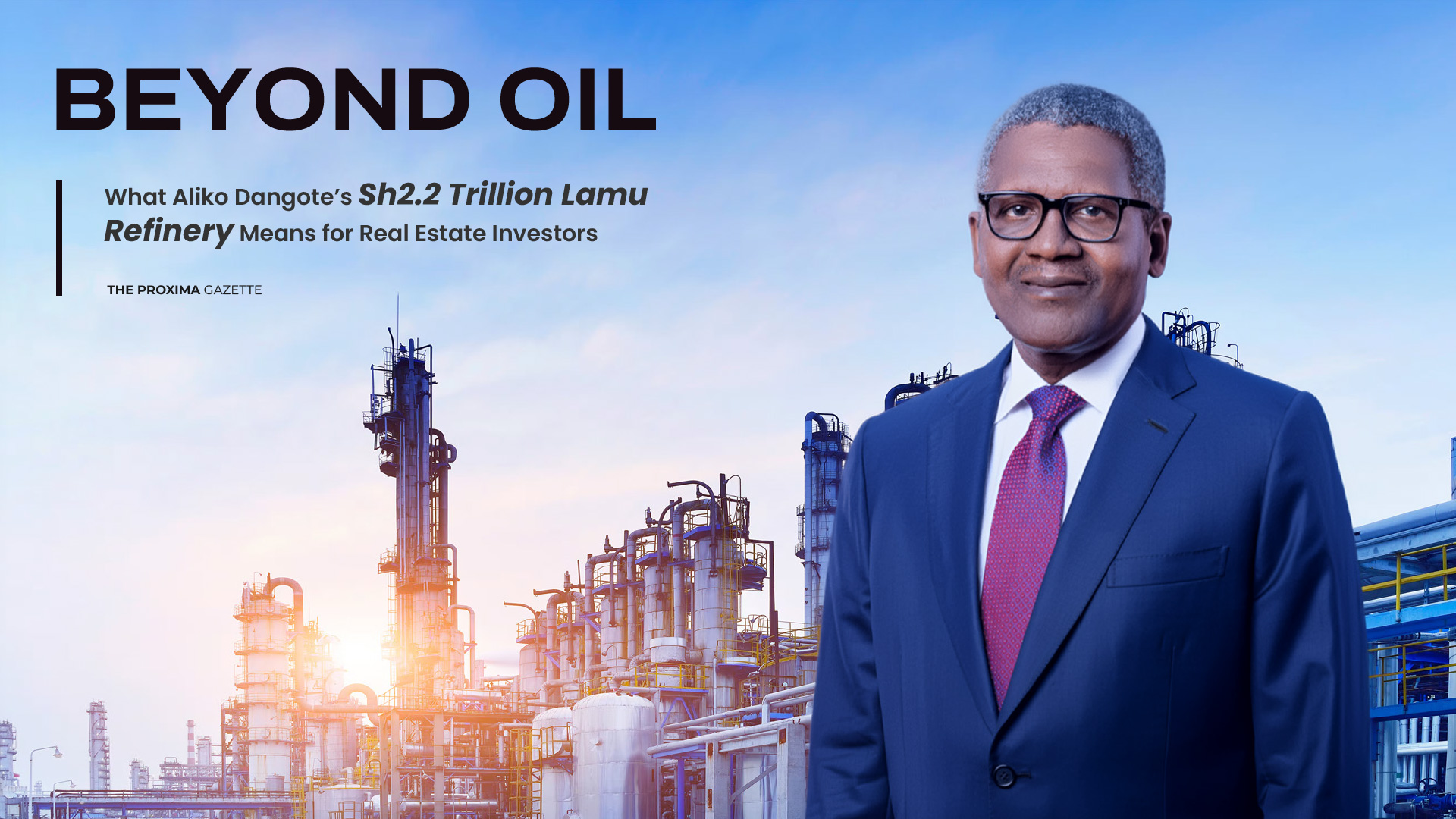
When Africa’s richest industrialist, Aliko Dangote, broke ground alongside regional leaders on a landmark Sh2.2 trillion ($16 billion) crude oil refinery in Lamu, the headlines naturally zeroed in on energy independence. Designed to refine up to 700,000 barrels of crude oil per day and anchor adjacent petrochemical and fertilizer complexes, the colossal development promises to reshape East Africa’s economic trade balance and end decades of reliance on imported fuel. Yet, if you look past the immediate industrial headlines, a far broader economic transformation is taking shape, one that holds immense implications for forward thinking real estate investors.
This landmark development is fundamentally an economic catalyst that puts Kenya at the center of international capital flows. History shows that whenever mega infrastructure projects of this magnitude take root, real estate markets undergo rapid structural evolution. A facility capable of refining hundreds of thousands of barrels daily requires thousands of engineers, logistics specialists, construction crews, and corporate executives. Every single one of those workers requires quality housing, modern amenities, commercial services, and reliable access routes.
The ripple effects extend well beyond immediate industrial boundaries. As construction ramps up along the Lamu Port South Sudan Ethiopia Transport (LAPSSET) corridor, the influx of capital sparks a domino effect across multiple property asset classes. Demand for workforce housing and executive residential units surges first, followed swiftly by industrial real estate needs such as warehousing, cold storage, and supply chain logistics hubs. Soon after, retail centers, office spaces, hospitality venues, and entertainment facilities emerge to serve an expanding, wage earning populace.
For property investors, the strategic imperative is clear: focus on prime locations, resilient developments, and zones poised for sustained long term demand. Infrastructure projects revalue surrounding land in distinct waves, first during the initial development phase, and again as full operational capacity takes hold. Those who identify key transport nodes, satellite urban centers, and high growth economic corridors early are best positioned to capture substantial capital appreciation and strong rental yields.
When you invest in real estate, you are never simply buying bricks, mortar, or parcels of land; you are buying a stake in the future economic productivity of a location. Major private investments of this scale signal precisely where regional population growth, commerce, and urbanization are heading next. The smart investor's strategy is to position their portfolio long before the full potential of these emerging growth hubs becomes obvious to the broader market.